Views: 0 Author: Site Editor Publish Time: 2026-10-19 Origin: Site


Multi-functional workstation sinks dominate social media feeds right now. You see satisfying cleaning videos highlighting peak aesthetic designs. But daily kitchen use is messy and demanding. Homeowners and remodelers struggle to separate high-utility upgrades from over-engineered gimmicks. Complex sinks often introduce plumbing headaches, demand excessive cleaning, or suffer premature hardware failure. We need to look past the viral appeal. This evaluation breaks down these advanced fixtures based on material integrity, plumbing requirements, and long-term maintenance. We will assess the true functional return on investment before you cut into your countertops or modify your supply lines. You will learn exactly what to look for in gauge thickness, valve construction, and drainage slopes to ensure your new sink actually works on a busy Tuesday night.
Utility vs. Complexity: While built-in rinsers, cutting board stations, and waterfall flows optimize prep and cleaning, they introduce multiple points of potential mechanical failure compared to standard basins.
Material Standards are Non-Negotiable: Long-term durability relies heavily on sourcing a handmade stainless steel sink (ideally 16-gauge, 304-grade with nano-coating) to support the weight of integrated accessories and resist scratching.
Plumbing Prerequisites: Upgrading requires assessing current under-sink infrastructure, specifically water pressure adequacy and the need for multi-way splitters or dedicated supply lines.
Maintenance Realities: Hard water scaling is the primary threat to digital displays, piano key buttons, and micro-nozzles, requiring proactive filtration or rigorous cleaning protocols.
A successful workstation sink transforms a basic basin into an efficient prep center. Ergonomics dictate the physical layout. You want to wash, chop, and drain without moving across the kitchen floor. Space efficiency improves when accessories sit flush on integrated ledges. Seamless drainage ensures food particles wash away quickly without pooling in the corners. These factors define high utility for anyone who cooks regularly. Poorly designed units become immediate liabilities. Clutter builds up when accessories lack proper storage or fit loosely on the tracks. Low water pressure renders advanced sprayers completely useless. Fragile components break under heavy daily use. We evaluate these sinks based on how well they balance complex features with everyday reliability. You need a setup that handles heavy cast iron pots just as easily as delicate wine glasses.
The physical footprint of the sink matters immensely. A workstation sink requires a minimum width to be effective. If you install a 24-inch workstation sink, the cutting board and colander will consume the entire basin. You lose the ability to actually wash dishes. A 30-inch or 33-inch basin provides the necessary horizontal space. You can slide the cutting board to the right and still access the garbage disposal on the left. The depth of the basin also plays a role. A 10-inch deep basin hides dirty pots from view and prevents splashing, but it forces taller users to bend over further. You must balance basin depth with your physical height and countertop level.
The waterfall feature provides a wide, gentle sheet of water. This specific flow pattern excels at washing produce. You can rinse berries, leafy greens, and delicate items without bruising them. Standard high-pressure sprayers often damage soft fruits or blast dirt deeper into the leaves. A waterfall kitchen sink solves this by distributing water horizontally across a wide slit. This horizontal dispersion integrates perfectly with multi-tier ledges. You place a stainless steel colander directly under the waterfall. The water washes over the food and drains immediately. Messes stay contained entirely within the basin walls.
Flow rate requirements dictate how well this feature performs. The horizontal water dispersion requires adequate pressure to maintain a uniform sheet. If your home's water pressure drops, the waterfall breaks into uneven, messy streams. Splashing becomes a major issue if the basin lacks proper depth or if the waterfall nozzle sits too high above the ledge. The necessity of a sloped basin drainage design cannot be overstated. Water must move quickly toward the drain to prevent pooling. Manufacturers achieve this through precise creased lines stamped into the basin floor. These X-shaped grooves guide water efficiently, keeping the workspace clean and dry after use.
Cup rinsers utilize high-pressure, upward-facing jets. This mechanical advantage targets the hardest-to-reach areas of your drinkware. Narrow-neck bottles, thermoses, and tall glassware present constant cleaning challenges. A standard pull-down faucet stream simply cannot generate the necessary upward force to scour the bottom of a travel mug. A kitchen sink with cup rinser blasts hot water directly into the base of the vessel. You press the glass down on the actuator star, the valve opens, and the jets dislodge stubborn coffee residue and dried smoothie remnants instantly.
Water conservation represents a significant, often overlooked factor here. Rinsers use quick, powerful bursts of water. You press down, the jets fire, and the glass is clean in two seconds. This method actually reduces overall water wastage. Continuously running a standard faucet to rinse stubborn residue consumes far more gallons per minute. Drainage mechanics beneath the rinser require careful engineering. The rinser base must angle slightly toward the main basin. This prevents standing water from accumulating around the actuator spring. Stagnant water breeds bacteria and creates unsightly mineral rings. Proper installation ensures runoff flows seamlessly into the primary drain without pooling on the countertop.
Structural differences between stamped sinks and handmade models dictate long-term performance. Stamped sinks are pressed from a single sheet of heated metal using a massive hydraulic press. This stretching process thins the material, especially at the corners and the bottom edges. Handmade sinks are cut from flat sheets, folded on a bending brake, and welded at the seams. This preserves uniform thickness throughout the entire structure. A handmade stainless steel sink features tighter radius corners. These zero-radius or R10 corners maximize usable basin space, allowing large baking sheets to lay flat. Handmade models also incorporate thick sound-dampening pads. These butyl rubber pads absorb the loud clanging of heavy pots and silverware, making the kitchen significantly quieter.
Material thickness is paramount for workstation sinks. We strongly advise using 16-gauge steel. This translates to roughly 1.5mm of thickness. The top lips often require even thicker steel, up to 3mm or 4mm. This reinforced rim prevents warping. Workstation sinks hold heavy accessories. Solid wood cutting boards, loaded colanders, and heavy pots rest directly on the integrated ledges. A thinner 18-gauge or 20-gauge sink will flex and bow under this weight. Structural integrity ensures the sink remains securely mounted to your countertop and the silicone seal remains watertight.
The nano sink trend dominates modern kitchen upgrades. Manufacturers apply PVD (Physical Vapor Deposition) nano-coatings to the stainless steel in a vacuum chamber. This creates a highly hydrophobic surface. We call this the lotus effect. Water and oil bead up and roll off the surface effortlessly. This coating aids in faster drainage and prevents grease from adhering to the basin walls. Cleaning requires only a quick wipe with a microfiber cloth. Abrasive chemical cleaners become unnecessary, which protects the finish over the long term.
Honeycomb embossed textures add another layer of durability. This geometric pattern is pressed directly into the steel sheet before the sink is folded. The texture reduces the surface contact area between heavy cookware and the sink bottom. When you drag a cast iron skillet across the basin, it glides on the raised honeycomb peaks. This prevents visible scratching and scuffing on the flat steel below. The combination of nano-coating and honeycomb texturing extends the visual lifespan of the sink significantly. It hides water spots and minor abrasions that would ruin the look of a standard brushed stainless finish.
Social media ads frequently push unbranded, white-labeled units directly from overseas factories. Purchasing these carries significant risk for the homeowner. You will likely face a complete lack of replacement parts. Warranties are often voided or non-existent. Non-standard threading on plumbing connections causes major installation headaches for your plumber. When a proprietary valve fails in two years, you cannot simply buy a replacement at a local hardware store. The entire sink may become unusable, forcing a costly replacement and countertop repair.
You must source your fixture from a reputable stainless steel sink manufacturer. Evaluate them using a strict checklist. Look for verifiable ISO certifications. Read the warranty terms specifically regarding moving parts and digital components. Ensure the manufacturer sells replacement cartridges and buttons directly to consumers. Established manufacturers provide detailed specification sheets and DXF files for countertop fabricators. They offer customer support for installation troubleshooting. Prioritizing a trusted brand protects your investment and ensures long-term functionality.
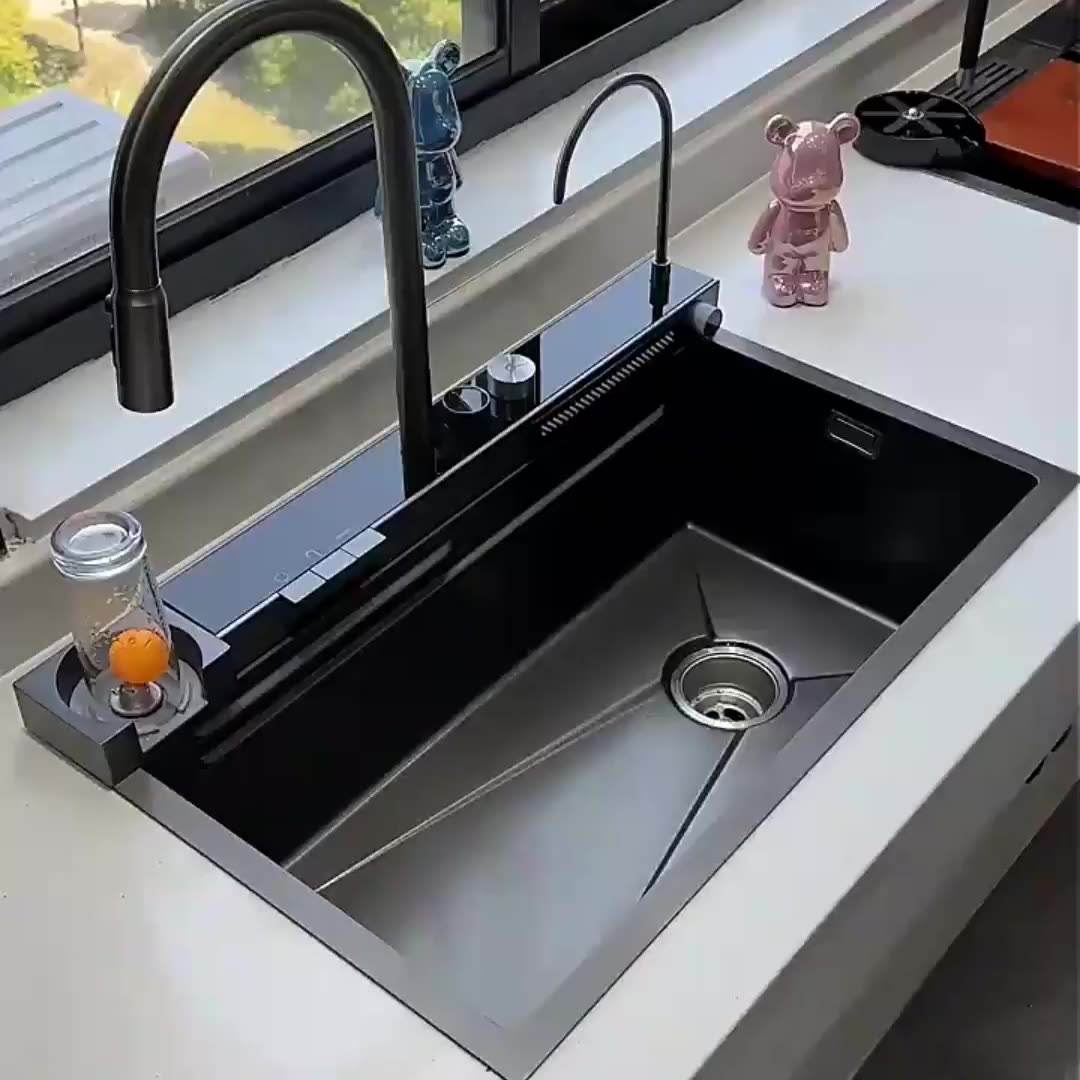
The piano key interface replaces traditional faucet handles with a row of push buttons. You press a specific key to toggle between the main pull-down faucet, the waterfall slit, and the glass rinser. This design offers distinct ergonomic advantages. You can activate water flow with a simple tap of your wrist or forearm. This proves invaluable when your hands are covered in raw meat, oil, or bread dough. A piano key smart kitchen sink streamlines the prep process significantly, keeping the main controls clean.
Mechanical reliability requires heavy scrutiny. These piano key buttons operate via internal spring-loaded valves. They are vulnerable to sticking. Grease, soap scum, and mineral deposits infiltrate the button housing over years of use. If a button sticks in the depressed position, water will not shut off. Regular cleaning of the interface panel is mandatory. You must wipe away moisture and debris daily. High-quality models utilize brass internal valves rather than plastic to mitigate this failure risk. Plastic valves will inevitably crack under repeated pressure, leading to leaks inside the cabinet.
Digital temperature readouts provide real-time water metrics. You know exactly when the water is safe for washing delicate items, bathing a baby, or activating baking yeast. Most units power these displays via internal hydro-electric generators. The flow of water spins a small turbine inside the supply line, generating electricity. This eliminates the need for hardwired electrical connections or frequent battery changes under the sink. It represents a clever, self-sustaining engineering solution that simplifies installation.
We must address the longevity of these components. LED screens exist in a high-moisture environment. Condensation and steam constantly assault the display housing. Hydro-generator failure rates increase over a 5-year horizon. Mineral buildup seizes the internal turbine blades. When the generator fails, the screen goes dark. The sink still functions mechanically, but the smart feature dies. Buyers must accept this reality. Choose models where the digital display is an added bonus, not a critical operational requirement. If the main mixing valve relies on the electronics to function, avoid the unit entirely.
Under-sink plumbing realities become complex with multi-functional sinks. A standard setup features one hot and one cold supply line connecting directly to the faucet tails. Workstation sinks require routing these lines into a central manifold. This manifold acts as a distribution hub. It feeds the pull-down faucet, the waterfall slit, and the glass rinser independently. You will likely need multi-way splitters or 3/8-inch compression T-adapters. The installation space inside your cabinet will become crowded with braided steel hoses and brass fittings.
Pressure drops present a major operational risk. When you use multiple features simultaneously, water pressure divides. The glass rinser requires a minimum of 30 to 40 PSI to function effectively. If your home suffers from low baseline pressure, the rinser will barely trickle and the waterfall will not form a proper sheet. You must test your static water pressure before purchasing. If pressure is inadequate, you may need a booster pump installed on your main line. The table below highlights the plumbing differences between standard and workstation sinks.
Feature Category | Standard Kitchen Sink | Multi-Functional Workstation Sink | Installation Impact |
|---|---|---|---|
Supply Lines | 2 (Hot and Cold) | 4 to 6 (Manifold distribution) | Requires T-valves and careful hose routing to prevent kinks. |
Minimum PSI Required | 20 PSI | 40 PSI (for rinser efficacy) | May require a pressure booster pump in older homes. |
Cabinet Space Impact | Minimal interference | High interference (hoses, generators) | Reduces available space for slide-out trash cans or storage. |
Drainage Setup | Standard center or offset drain | Offset drain with sloped X-grooves | Requires re-routing the PVC P-trap toward the back wall. |
Installation constraints differ wildly between drop-in and undermount configurations. Drop-in sinks rest their weight on the countertop surface, supported by the oversized rim. Undermount sinks hang suspended beneath the stone. Workstation sinks are exceptionally heavy. When loaded with water, wet cutting boards, and cast iron pots, the downward force is massive. Undermount installations require heavy-duty support clips, threaded inserts, and industrial-grade epoxy. Many installers build custom wooden support frames inside the cabinet to bear the load safely and prevent the sink from separating from the quartz or granite.
Cabinet modifications are frequently necessary. These basins are often deeper than standard models, reaching 10 inches or more. This depth intrudes on vertical storage space. Offset drains push the P-trap toward the back of the cabinet. This clears space in the front for storage, but requires re-routing the PVC waste lines. You must measure your current under-sink clearance meticulously. Account for the complex plumbing manifolds required for the smart features and the depth of the basin. Failure to plan will result in a sink that simply does not fit your existing cabinetry.
Hard water is the absolute enemy of multi-functional sinks. Calcium and magnesium scaling attack the specific vulnerabilities of these units. The narrow waterfall slit clogs easily. When minerals build up, the smooth sheet of water splutters and sprays erratically across the kitchen. Rinser micro-nozzles suffer the same fate. The high-pressure jets lose their force as scale restricts the aperture. The piano key buttons will grind and stick if calcium deposits form inside the brass valve housings.
Mitigation strategies require proactive effort. If you live in a hard water region, a whole-home water softener is highly recommended. Alternatively, install an inline water filter on the supply lines feeding the sink manifold. Routine descaling maintenance is non-negotiable. You must soak the rinser nozzles and waterfall slit in white vinegar monthly. Use a soft nylon brush to dislodge mineral flakes. Ignoring this maintenance guarantees premature component failure and a frustrating user experience.
Homeowner skepticism frequently surfaces on remodeling forums. Users question the long-term reliability of these all-in-one units. The primary concern is cleaning. Integrated tracks, cutting boards, and multi-tier ledges feature corners and crevices. Food particles, raw meat juices, and grease accumulate in these tracks. Cleaning a smooth, standard basin takes seconds. Scrubbing the tracks of a workstation sink requires dedicated time and a small detail brush.
You must weigh the time saved washing dishes versus the time spent cleaning the sink's components. The glass rinser saves immense time when cleaning bottles and thermoses. The waterfall saves time washing vegetables and prepping salads. You must dedicate time weekly to clean the ledges and descale the nozzles. For avid home chefs who prep fresh food daily, the functional return on investment is high. For homeowners who rarely cook and rely on takeout, the maintenance overhead outweighs the benefits. Assess your actual kitchen habits before committing to the upgrade.
Measure your current under-sink cabinet clearance, accounting for a 10-inch basin depth and the complex manifold routing required for advanced features.
Test your home's static water pressure with a gauge to ensure it meets the 40 PSI minimum required for the glass rinser to function properly.
Purchase a cup rinser sink with waterfall faucet from an established manufacturer that guarantees 16-gauge 304 stainless steel and provides accessible replacement valves.
Consult a licensed plumber to evaluate your current supply lines, discuss the installation of multi-way splitters, and build a custom wooden support frame for undermount installations.
A: While standard hot and cold water lines are used, a multi-way splitter or custom manifold is required. This routes water to the main faucet, the cup rinser, and the waterfall independently. Your cabinet must have enough space to accommodate these extra braided hoses.
A: We recommend 16-gauge (1.5mm) stainless steel for the main basin. The top rim should ideally be up to 3mm thick. This heavy-duty construction is necessary to support the weight of workstation accessories like cutting boards and heavy pots without flexing.
A: Glass rinsers actually reduce overall water wastage. They use short, high-pressure bursts to blast residue out of narrow-neck bottles. This targeted cleaning method is far more efficient than running a standard faucet continuously to achieve the same result.
A: Most models do not require a standard 110V outlet. They utilize internal hydro-electric generators powered by the flow of water. This spins a turbine to power the digital LED display. Some alternative models may require standard batteries.
A: Hard water will cause severe scaling on the micro-nozzles and the narrow waterfall slit. Frequent descaling with white vinegar is mandatory. Installing an inline water softener is highly recommended to maintain adequate water pressure and proper flow shape.
A: Nano-coatings create a hydrophobic surface that repels water and oil, making the sink much easier to clean. Honeycomb embossing is a physical texture pressed into the steel. It prevents heavy pots from making full contact, thereby preventing visible scratches.
A: A minimum of 30 to 40 PSI is generally required. This pressure is necessary to generate enough upward force to effectively blast dried residue out of tall glasses and narrow-neck bottles. Lower pressure renders the rinser ineffective.

